
By: Sylene Argent, Local Journalism Initiative Reporter, Essex Free Press
At the federal-level of government, Bill C-9 – an Act to amend the Criminal Code (hate propaganda, hate crime, and access to religious or cultural places) – passed its third and final reading in the House of Commons on March 25. That was with support from the initiating Liberals, in addition to the Bloc Québécois.
Conservatives, NDP, and the Green Party opposed the bill.
It is now being reviewed at the Senate-level, a process that needs to take place before official adoption, where it has passed its first reading of three there just a day later.
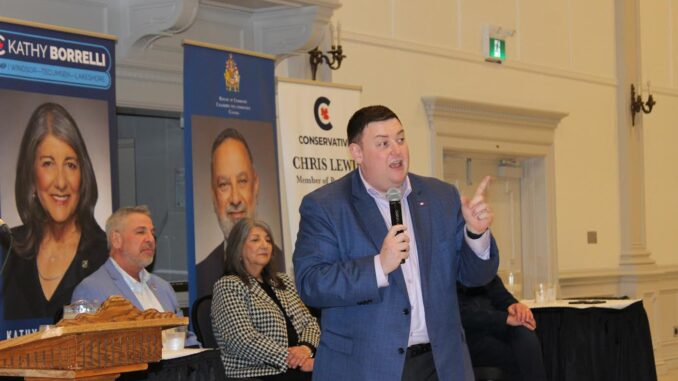
Elgin-St. Thomas-London South MP Andrew Lawton hosted a town hall meeting to discuss the Bill on the evening of Tuesday, March 31 at the Ciociaro Club, as he has done in communities across the country. He joined area Conservative MPs Chris Lewis (Essex), Harb Gill (Windsor West), Kathy Borrelli (Windsor-Tecumseh-Lakeshore), and Dave Epp (Chatham-Kent-Leamington). They used the opportunity to share their concerns with the Bill with the around 200 individuals who attended, many wearing different religious garb and symbols.
Lawton is urging Canadians to reach out to Senators to express their concerns.
As a member of the House of Commons’ Standing Committee on Justice and Human Rights, Lawton was glad to see so many attend the event, where he shared his concerns then turned the mic over the crowd to answer questions and listen to feedback for around an hour.
“Let me say that hate is real,” Lawton, a Christian, said before those in attendance, listing various examples of hate directed at various faith groups.
“Religious freedom for one is religious freedom for all,” Lawton said. “If we do not protect the Charter of Rights – the core fundamental rights and freedoms for all faith communities in this country – and the rights of all Canadians – none of us will have these rights in the future.”
That is why C-9 is so important.
Background on C-9
Minister of Justice and Attorney General of Canada Sean Fraser sponsored Bill C-9, which Liberals are saying on its www.justice.gc.ca page would “amend the Criminal Code to propose new offences to better protect access to religious, cultural, and other specified places, and to address hate-motivated crimes.”
The proposed amendments in the Bill would create an intimidation offence that prohibits conduct that is intended to provoke a state of fear in another person to impede them from accessing religious or cultural institutions and other specified places; an offence that prohibits the intentional obstruction of a person’s lawful access to such places; a hate crime offence to more explicitly denounce hate-motivated crime; and an offence that prohibits wilfully promoting hatred against any identifiable group by displaying, in any public place, certain hate or terrorist symbols.
Lawton noted that when it was first introduced, the definition of hate was changed to what he said lowers thresholds. That was fortunately fixed through committee work, he said.
The Bill also named it an offence to block someone from entering a place of worship. That is already illegal, he noted.
More info can be viewed at www.justice.gc.ca/eng/csj-sjc/pl/charter-charte/c9_2.html
Concerns Conservatives are raising:
During deliberation with the Standing Committee on Justice and Human Rights, the Bloc – with support of the Liberals – removed the “Religious Defence” portion, which said one cannot be willfully charged with willfully promoting hate if expressing – in good faith – a religious belief or citing a religious text, Lawton explained.
That is important, because the Criminal Code provision only applies to willful promotion of hate, he added.
It only applies to people who expressly view in good faith.
“You can’t call for violence in good faith. You can’t commit an act of violence in good faith. You can’t whip up the really vile hatred that does cross that threshold into being illegal in good faith,” Lawton explained. “So, when you remove a protection that only applies to people making a good faith religious belief, the only people you remove protections for are those of faith.”
Lawton spoke of the Standing Committee on Justice and Human Rights committee meeting from October 30, 2025, and comments MP Marc Millar, who was the Chairperson at that time, made.
Millar commented that “Clearly, there are situations in these texts where these statements are hateful. They should not be used to invoke or be a defence. And, there should, perhaps, be discretion for prosecutors to press charges,” Millar said in that meeting of the Bible and other religious texts.
Liberals cut short debate, denied opportunity to hear witness testimony on religious freedoms, only provided a day-and-half in the House of Commons before it was forced to a vote, Lawton said.
Faith leaders, Lawton added, are on the frontlines of many issues facing society – and provide answers to those problems – such as hearing struggles youths are going through, collapsing marriages, and seeing economic trends when individuals lose their jobs or can’t afford the cost-of-living.
“We can’t reap, as a society, the philanthropic benefits of what faith groups do, if we do not protect the right for faith organizations to live out their religious values and beliefs and practices. And the way you combat those who do twist or distort religious teachings to suit a negative aim is by allowing everyone the freedom to call them out,” Lawton suggested.
“The Charter is valuable and vital,” Lawton said. “It does not stop government from violating your rights in real time. It provides a mechanism you can use to challenge it afterwards.”
It can take years to get a declaration that your rights were violated, he noted.
“The way we protect our rights is by stopping laws in their tracks that are going to violate those rights,” Lawton said.
The biggest concern with Bill C-9, Lawton commented, “is that no community will be protected from hate by legislation that really infringes on their fundamental rights. This is a Bill – that in its current form – removes long-standing protections that people of faith have enjoyed.”
It is Freedom of Expression in general that is engaged by this, he added.
Lawton said many have reached out to his office about the Bill, and in talking to Members of Parliament who have been in office longer than he has – the volume of correspondence they have gotten on C-9 – “is massively outweighing things they have gotten on any other issue. There is clearly a concern there.”
The most important thing “is that we need to ensure the law is dealing with behaviour that is infringing on other people’s rights. This means that when people are threatening violence, when people are blocking or obstructing access to holy sites, that we are enforcing laws that exist there,” Lawton added.
In terms of speech, he said there is already a threshold in Canada that has been working for decades that the Supreme Court has fine-tuned over many years.
“Our view is that we don’t need to reinvent the wheel when we have an existing legal standard that has been working and has provided a level of clarity to law enforcement and to courts.”
He cautioned that if existing laws are not enforced, new laws are not going to solve that underlying problem.
MP Lewis said his office has been inundated about concerns with C-9. He noted Lawton knows the Bill well, and “knows all the reasons why it’s totally infringing on Canadians’ rights and freedoms, but specifically to their religion.
“We know C-9 is wrong. We know C-9 is trouble. It’s one more time the government wants to take away our rights, but we also know it is worth the good fight and we are going to continue to do that.”
He believes faith is much stronger than government.
MP Gill said he was a police officer for nearly 30-years in Toronto and LaSalle. “We are not for hate, we are against hate,” he said of the MPs.
“We are against legislation that makes things harder for the average Canadian and certainly for Police Officers.”
Police, he explained, are the ones who have to enforce law. If the law is not written clearly, they are difficult to enforce. If a law is not applied across the board in an even fashion, the public may view it as unfair.
Gill sees C-9 as lacking common sense.
2025 Essex Riding Liberal candidate weighs-in
Essex Riding Liberal candidate in the 2025 election Chris Sutton took to social media to criticize the Conservatives’ town hall meeting to discuss C-9.
It is his opinion “the law still requires a high-threshold of wilful promotion of hatred, not disagreement, not opinion, not quoting scripture. What’s changing is that you don’t get a blanket ‘free pass’ to promote hatred simply by claiming it’s rooted in religion.
“Because let’s be honest, freedom of religion was never meant to shield hate or intimidation. You are absolutely free to practice your faith. You are not free to target, threaten, or incite hatred against others under the guise of that faith. Big difference.”
He suggested the town hall offered a “one-sided narrative that suggests basic protections against hate somehow equal a loss of freedom.
“The irony? The same people claiming to defend ‘freedom’ seem pretty comfortable ignoring the freedom of others to safely gather and worship without intimidation. No one is losing their right to believe. They’re just losing the ability to hide behind that belief to justify promoting hate,” Sutton wrote.